Are Dentures Better Than Bad Teeth . Dentures are generally the poorest quality of tooth replacement. Help with eating and chewing; Foods That Are Bad for Your Teeth Jefferson Dental from www.jeffersondentalclinics.com In this case, a denture would be better. Reduce wrinkles fill lips and skin out around month area; There are a few ways you can make your dentures fit better.
Energy Released In Beta Decay. N → p + e− + ν (β− decay, eg. I will leave you to calculate the mass converted into energy during the decay!
PPT Nuclear Energy PowerPoint Presentation, free from www.slideserve.com
Beta decay is a type of radioactive nuclear decay. Calculate the energy released in the beta decay of 32 15p. Yes, beta decay releases energy.
With Alpha, Beta, And Gamma Decay , The Element Changes.
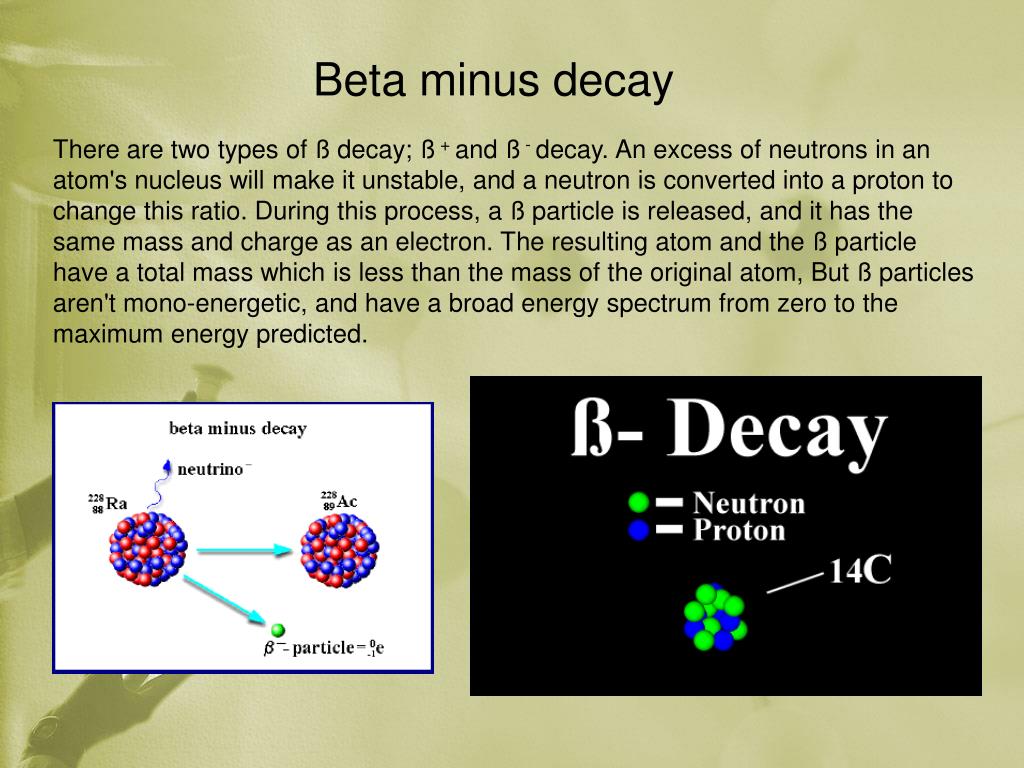
By beta decay emission, a neutron is transformed into a proton by the emission of an electron. Therefore, beta particles emit kinetic energy ranging from 0 to q. A beta particle (β) and an antineutrino ( ).
Beta Decay Is A Radioactive Decay In Which A Beta Ray Is Emitted From An Atomic Nucleus.
The masses of 22 na and $^ {22}\textrm {ne} are 21.994434 u and 21.991383 u, respectively. If a beta particle has 650 kev how much energy foes the antineutrino have? Question by openstax is licensed under cc by 4.0.
Yes, Beta Decay Releases Energy.
Calculate the energy released in the beta decay of 32 15p. The decay process provides a certain amount of energy, e m, which depends on the particular radioisotope. The nucleus, which is extremely heavy compared to the two other two, takes a negligible part of the available energy, which is shared in practice between the electron and the antineutrino.
Gold 7 9 1 9 8 A U Undergoes Β − Decay To An Excited State Of 8 0 1 9 8 H G.
How much energy is released in the beta decay of 14 c? When a “radioisotope” (short for radioactive isotope) undergoes beta decay, two particles emerge: Itis typicallyon the order of 1 mev.
Calculate The Energy Released In The Β + Decay Of 22 Na , The Equation For Which Is Given In The Text.
Radionuclide decay tables often provide energy released in mev. This energy is split between the particles according to probability: Most of this energy is in the form of the kinetic energy of the emitted electron.


Comments
Post a Comment